Just a quick note to say that we're back from holidays, but with the gale force south-easterly gales causing transport problems for the island (the Northlink ferries to and from Lerwick were cancelled last night and the Good Shepherd hasn't managed any sailings whilst we've been away) we've not made it back to Fair Isle yet. We're going to try for the start of next week, but until then we'll not be able to pick up messages, emails etc, so thanks for your patience if you're waiting for us to get back to you.
It sounds like most of the island has stood up to the worst of the weather fairly well, the Obs is still there although the Ringing Hut (which in fairness, had seen better days) has been blown away! There have been several additions to the year list (thanks to updates from Deryk and Tommy), with more regular stock inlcuding Bar-tailed Godwit, Ringed Plover and Oystercatcher and winter highlights of Waxwing (briefly at the Haa), an adult Little Gull and at least 13 Tundra Bean Geese. These latter two species join Velvet Scoter as species that failed to appear on the island in 2013 but have already made it in 2014 - could the year list record be on?!
Hopefully we'll be back soon (I might bore you with a few of my holiday photos when we make it) and hopefully I'll not miss anything big before then (Lesser White-fronted Goose, Ross's or Ivory Gull or Bittern could all be possible given the forecast...).
EDIT: I was close - Bittern turned up in Shetland later in the day I wrote this (a species still missing from the Fair Isle list). Fair Isle weighed in with some good birds as well with Coot (virtually annual in recent years, but always a good one to get) found by Deryk on Da Water and, Pochard on Tommy's garden pond. The Pochard is a rare bird on Fair Isle, with the one last year (which I thankfully jammed in on, seeing it on its last day on the day I got back from holiday - although I almost wasn't told, as nobody realised how scarce they are on Fair Isle!) being the first for about five years. There are also a few more Bean Geese, one or two Iceland Gulls and plenty more Kittiwakes. I seem to recall in the olden days, a winter influx of Kittiwakes was always thought the best chance of finding a Ross's Gull, so I'm hoping that, if it happens, it waits until Monday when I (hopefully) get back.
Wednesday, 29 January 2014

Wednesday, 8 January 2014
New Year, New Birds, New Jobs...
Susannah and I would like to wish Friends of Fair Isle, visitors to the Obs and readers of the blog a very Happy New Year, all the best for 2014 and we hope to see you up here at some point!
The birding has got off to a good start, with a very respectable 45 species recorded on New Year’s Day, despite a feeling that there wasn’t that much about. It was helped by the sunny and quite pleasant conditions, as the mild, but at times very windy, weather has continued.
The undoubted highlight was the Velvet Scoter, which flew out of Furse and past Buness, not only a Fair Isle tick for me, but the first live one to be seen from the island since 2011 (a freshly dead bird was found in 2012). It’s remarkable that after one of the best ever years for number of species seen in 2013 (the current total is 214 if everything is accepted by the relevant committees), we should record a species that didn’t make it onto the year list just a day later. Does it bode well for the year ahead? Maybe…
Other birds of interest as the New Year broke included a first-winter Glaucous Gull, 3 Little Auk off South Light, a Chaffinch (a male that arrived at the Obs on the 1st and is still present), a scattering of thrushes including around 20 Fieldfare, a few wildfowl including a couple of Long-tailed Ducks, a Whooper Swan and a Common Scoter, 2 Jack Snipe (flushed from Boini Mire with around 40 Snipe) and unseasonal Woodpigeon, Meadow Pipit and Dunlin. Since the 1st there has been little of note, although Merlin, Water Rail and Guillemot have made it onto the year list, whilst Tysties were just offshore and whistling in good numbers on an almost balmy 5th. It’s interesting that Guillemots have not made it onto the cliffs yet – this time last year they were regularly present in early January.
Some other news:
• Staff and volunteer vacancies are now available for 2014, check the relevant page on the blog.
• The 2012 Annual Report is out (having had a few weeks waiting at Grutness!). It contains the systematic list, ringing report, seabird report , details of other wildlife and write-ups of Eastern Grasshopper Warbler, Magnolia Warbler, Siberian Rubythroat, Eastern Subalpine Warbler and much more. Send a cheque (made out to ‘FIBO’) for £11.50 (inc p&p) to the Obs if you’d like your copy, or join FOFI to receive a copy every year.
 |
| FIBO's very own version of Santa's elves get to work sending Annual Reports all around the world. |
We’re away now until the end of the month, so we’ll try to answer all our messages as soon as we can in early February.
Right, I best go and pack…
Tuesday, 7 January 2014
December Birds
 |
| I'm dreaming of a white-horses Christmas. The view from the Obs on Christmas morning - another windy day. The weather has been rather wild over the winter, with the Good Shepherd unable to sail for 19 days at one stage. |
.jpg) |
| Not on Fair Isle. This fine ad Med Gull was at Marsden on the Durham coast and one of four or five we saw during our failed search for something even better (although Med Gull would have been a good enough bird in Durham itself back in my day). |
Also unusual for the time of year were Black-tailed Godwits on 5th and 19th (spilling over from the North Ron wintering flock perhaps?) whilst other waders included peaks of 130 Turnstone, 30 Redshank, 13 Curlew, 5 Lapwings, 15 Purple Sandpipers and a Jack Snipe.
Typical wintering fodder were up to 15 Redwing, 10 Blackbird, 2 Fieldfare, a Song Thrush, 5 Robin, 6 Twite and 28 Snow Bunting, although a Meadow Pipit on 29th was less usual, as this species is largely absent from Fair Isle in the winter (only a few of the smaller birds tough it out, with the wintering passerine list above being added to only by Starling, House Sparrow, Rock Pipit and Fair Isle Wren). Birds lingering from earlier in the year included Grey Heron (to 13th), Merlin and two Water Rail (the latter two species seeming set to winter), whilst a Woodpigeon from 22nd was no doubt a bit puzzled as to where it had ended up.
 |
| Any other wildlife? New Year guising. |
 |
| We hope you all had a good Christmas and New Year, we certainly did! Best wishes to you all for 2014 from all the Parnabys and everyone else from FIBO and thanks for your support during the last year. |
Thursday, 28 November 2013
Remember, remember, the blog in November.
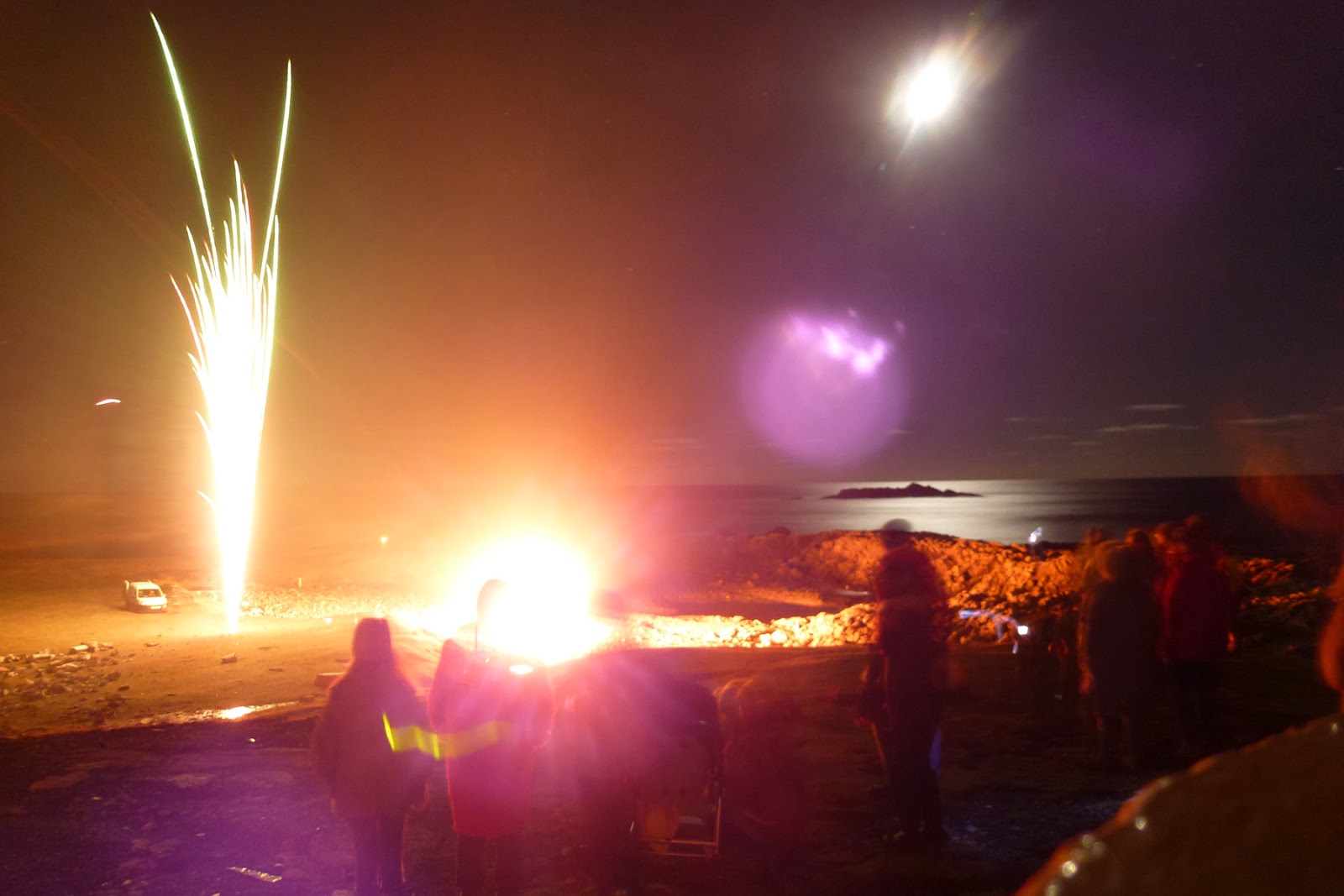 |
| Bonfire night was put back due to poor weather, as November has seen a succession of windy and wet days, interspersed with some pleasanter weather, although the island is still pretty soggy. |
 |
| We don't get to go out much as a family during the Obs season, so whatever the weather, we try to make the most of the winter. |
Let’s start with the birds. There was a general theme of a few lingering highlights at the start of the month, then things quietened down before an unexpected late fall on 12th then a gradual decline in numbers and variety again as another fabulous autumn finally drifted away to be replaced by the typical winter fodder of wind, few birds and a ridiculous amount of paperwork (over 70 descriptions amassed this year – sorry if I’ve mentioned that before, but between that and Annual Reports, it’s fair to say that I’m not exactly sitting back with a cigar on at this time of year!).
 |
| Sparklers - better than cigars! |
The 12th also produced counts of 37 Woodcock, 646 Blackbird, 164 Fieldfare, 93 Redwing and 11 Robin (including the Dutch-ringed bird that seems to be attempting to overwinter at the Obs), although with only two people covering the island, these are likely to be underestimates, particularly of Woodcock which were probably spread thinly across the whole island.
 |
| Thrush numbers have dropped right off since the fall a couple of weeks ago. Fieldfares and Song Thrushes are now pretty hard to come by, whilst just a couple of dozen or so Redwing and Blackbirds are hanging on. |
Lingerers included the Olive-backed Pipit (to 2nd), Richard’s Pipit (to 12th), Bullfinch (to 2nd), Grey Wagtail (to 16th), Hen Harrier (to 9th), Chaffinch (with 2 still present), Brambling and Mealy Redpolls (up to 10) to mid-month, Chiffchaff and Blackcap (both to 19th), Goldcrest (1st), Woodpigeon (to 2nd), whilst the last Bonxie was seen on 8th and the Tree Sparrow that turned up in mid-June finally departed (it was last seen on 6th).
 |
| At least one (probably two) Hen Harrier remained into November, with one spending most of its time on Gilsetter, so it could be seen most days from the road on the School run. |
 |
| In the absence of any of its friends, this Whooper Swan did the best it could and started hanging out with the sheep on Suka Mire. |
 |
| Not quite an annual species on Fair Isle, these Goosanders were the first since the wintering bird of 2012/13 was last seen on 1st January. |
A few updates from wildlife sightings from the last few weeks, starting with those immense Killer Whales that appeared at the start of the month. Andy Foote from NAKID has identified the individuals as a group that are regularly seen in North Scotland and the Northern Isles (and as far as the Faroes) in the winter and spring, with the male being about 19 years old and the youngest a calf from the winter of 2009/10.
 |
| The animal on the right is older than a few of our volunteers this year. The slight haziness of the photo is due to the animals swimming through a rainbow! |
 |
| One of the Siberian Chiffchaffs trapped on 15th October. |
+smaller.jpg) |
| The Arctic Warbler on 15th October feeding at Shirva having being ringed the previous evening at the Obs. Although a Japanese Leaf Warbler would have been nice, the fact that it looked like an Arctic Warbler (albeit a strong-billed one) made it quite pleasing that the DNA backed this up. Surely that would have been a tremendously underwhelming way to add a species to the British list! |
So, I still await the ultimate prize of a first for Britain during my time as Warden, but on the subject of winning prizes (see what I did there?), there are a couple of awards to mention. FIBO itself has won a Shetland Environmental Award in recognition of our work and the green credentials of the building, whilst Nick Riddiford’s efforts in campaigning for a Marine Protected Area were rewarded with a Nature of Scotland Award.
 |
| Former FIBO Warden and current Fair Isle resident Nick receiving his award. (c) RSPB |
Congratulations Nick, a well deserved award and everyone at FIBO hopes you are rewarded with the prize you really want and thoroughly deserve – suitable protection for the waters around Fair Isle.
 |
| It's been generally too cloudy for much Aurora action so far this winter, but there was a good show on 31st October, a great way to end the season! |
 |
| Bonfire night and a great array of hats (note: not all of these are authentic Fair Isle knitwear!). |
Friday, 1 November 2013
Seal meat again.
1st November
It's the end of the season, the final guest has left (a day late after the planes were cancelled yesterday) and most of the staff have gone after a very busy season. Many thanks are due to all of them for their efforts this year - it's been another good one, so thank you Will, Richard, Teresa, Ann, Graham, Becki, Tracey, Steffan, Billy, Noa, Kieran, Daniel, Jake, Alex, Livvy, Chris, Rachel, Tim, Maggie, Liz, Jenny, Janet, Sally, Julia, Rob and Tegan and of course, Susannah. The Directors of FIBOT have also provided their usual mix of enthusiasm and expertise, which is so important to the Obs. There are many more people who help the Obs in a crucial way during the year and so thanks are also due to the many islanders who have helped out during the year including Angela, Hollie, Deryk, Raluca, Alice, Iain and Kenny who have all done various jobs at the Obs and for the many others who have helped out in other ways including Robert & Fiona, Jimmy & Florrie, Nick & Elizabeth, Elena, Tommy & Liz, Neil & Pat and Dave. Massive apologies to anyone I may have missed and thanks to all the islanders for their friendship and support. Susannah, the kids and I are very lucky to live on Fair Isle, not just for the birds and the beauty of the island, but especially the people.
Thanks also, of course, to all of you who have helped FIBO to continue its work, by visiting, volunteering or joining the Friends of Fair Isle.
I'll try to complete a more thorough summary of the year later, but as a brief look back, 2013 will be remembered from an ornithological point of view as another poor year for most seabirds but an excellent one for rare migrants. A regular dose of rarities (although a lack of many large falls) has brought us over 70 descriptions (around half of them for BBRC), a current year list of around 212, with over 3500 birds (of over 110 species) ringed and two additions to the Fair Isle list (Swinhoe's Petrel and Red-eyed Vireo taking the island list to 381: with a few potential splits maybe on the cards [my money is on the Subalpine Warblers, Eastern Yellow Wagtail, and hopefully Eastern Grasshopper Warbler, with a few geese maybe to come as well] I wonder how long it will take to get to 400?).
Today's plans for a quiet day were somewhat scuppered by the appearance of Killer Whales actually in North Haven. The five animals then spent a few hours hunting seals from Buness to North Light, although they often went missing for spells. What a way to end the season!
 |
| Dum, dum. Dum dum. Du du duu du, du du duu du... |
 |
| ...DA DA DA DAAA. When Killer Whales are too close to fit in frame, you know it's been a good day. |
 |
| The North Haven regularly holds small numbers of Grey Seals and, once they are trapped in there by a pack of hunting Killer Whales, their only escape is to stay in very shallow water or haul out onto land. A surge in Killer Whale sightings late in the autumn seems unusual, but perhaps there is a group in the area that knows the seals are vulnerable as they pup and mate on beaches around the island. |
 |
| Not all the seals were quick enough to get out of the way; the Whales' first foray into North Haven was soon accompanied by a cloud of gulls and a few chunks of floating flesh, evidence of a succesful kill. |
 |
| Hopefully the photographs may enable us to learn more about the history of these individuals. Five animals were involved in today's sightings, including one adult male and at least one probable immature male. |
 |
| Don't look behind you! The group then moved into Furse where they spent around half an hour circling this seal trying to dislodge it from its tiny haven. |
 |
| The scale of these enormous beasts was readily apparent as they repeatedly circled just below the cliffs. |
 |
| Tail-slapping by one individual in particular may have been a signal to other members of the group, or perhaps it was an attempt to startle the seal and get it to make a break from its precarious position. |

 |
| Close runs by the rock may have been intended to try to wash the seal into the water. At times, all the whales would head off slightly and seemingly regroup, before charging back in. It was as if they were having a little meeting away from the seal's earshot to discuss their next move! |
 |
| The tense stand off amazingly saw the seal hold its nerve and remain on the rock until after the Killer Whales were well clear (by the time they returned 15 minutes or so later it had gone - and presumably had quite a story to tell all its seal friends). They came back into the Havens at least half a dozen times during the afternoon, presumably hoping to surprise another seal, although they weren't seen to kill anything else. |
 |
| The bull would occasionally hold back and seemingly watch the rest of the group as they hunted. |
 |
| After a last, brief pass through the North Haven, the group were last seen heading out past North Light. It's been a tremendous year for Killer Whale sightings, with each one proving an exhilarating experience (not least for Becki, who first spotted them in the North Haven from the Obs lounge window). At one stage, we left Grace at the window to watch out for their return - her prompt shouts enabled us all to get more good views as they made their final return into the North Haven! Whale-spotter is not a bad addition to the CV for a four year old! |
A quick update on birds as well from the last few days, which has felt very much like the end of the autumn. A few arrivals still occurred, with Red-breasted Flycatcher and 2 Linnet (27th), and a day of finch movement on 28th brought a new Bullfinch (which remained to 31st), 5 Greenfinch and 3 Crossbill. On 31st there was a Long-eared Owl (in another quiet autumn for the species) and 31 Woodcock. Lingering birds included the Olive-backed Pipit (to 31st), Richard’s Pipit (to 29th). Other lingering species included up to 209 Snow Buntings, 2 Lapland Buntings, small numbers of Common Redpolls, up to 2 Grey Wagtail, a Tree Sparrow (still present from the late spring), up to 2 Black Redstart and small numbers of Blackcap (although the last Chiffchaff so far was seen on 29th). There was a noticeable clearout of thrushes on 31st as the birding started to settle into the winter routine.
Typically, a few white-wingers started to appear with up to 2 Glaucous Gulls (an adult and juv) and a first-winter Iceland Gull (1st), whilst Little Auks on 28th and 31st were also typical for the time of year (although the latter heading over the Kirk was less typical). A Great Northern Diver, up to 23 Long-tailed Ducks and a Sooty Shearwater (from the Good Shepherd on 29th) were the highlights from the sea, whilst the marshy areas yielded an impressive 132 Snipe (28th) with up to 5 Jack Snipe amongst them. A few Whooper Swans and small groups of Pink-footed Geese passed through, whilst a Hen Harrier lingered to 1st at least.
Saturday, 26 October 2013
Crossing the Ruby-gone
23rd-26th October
 The Siberian Rubythroat was seen again on the morning of the 23rd, but with conditions deteriorating there was no sign later on so, sadly, it proved untwitchable for anyone not lucky enough to be on Fair Isle at the time. A brave effort was made by a charter plane that had got close to Fair Isle on the basis of the positive news from the morning, before low cloud over the airstrip caused their diversion to Sumburgh (where they learnt of the Cape May Warbler on Unst that was also out of bounds due to poor visibility). Although the cloud lifted for a short while in the late afternoon allowing their plane to get in, the 45 minutes or so available on Fair Isle weren't enough to turn up the Rubythroat and so they had to return home empty handed. I suppose twitching wouldn't be fun if you got the bird everytime, but it doesn't feel that way at the time (I've quit twitching several times after long-distance dips!).
The weather has also meant that we went without any transport to or from the island from last Friday until Thursday evening, although planes have now finally reached us and there is hope that the Good Shepherd will sail on Saturday. Everyone has coped remarkably well with the issues surrounding being stranded; missed international flights, missing family, delayed trips to Unst (although several people have now made it from Fair Isle to see the Cape May Warbler) or the threat of continental breakfast on Saturday instead of the usual full Scottish. No doubt being present for the stonking male Rubythroat helped matters.
Although the last few days of October have turned up some cracking rarities in their time, there is now a distinctly ‘end of season’ feel to the island, with only a few new migrants noted in the last couple of days as the weather has started to feel more wintry and less autumnal.
A Barred Warbler was new (and rather late) on 23rd, when there were also 2 new Little Buntings (one of which lingered to 24th) and a Ruff, whilst 2 Black Redstarts appeared on 24th (in what has been a quiet autumn for them so far).
Lingering birds of interest included the Olive-backed Pipit (now ensconced at Stackhoull), Red-throated Pipit (to 24th), Richard’s Pipit (to 23rd at least, although a large pipit seen briefly near Taft on 25th was presumably the same bird), 2 Bullfinch (to 23rd), Great Spotted Woodpecker (to 24th) and a Goldfinch.
There were also still up to 4 Crossbill, 3 Yellowhammer and a selection of Redpolls that included a good candidate for a Coue’s Arctic on 22nd-24th, although generally there were fewer migrants with a notable decrease in thrushes and warblers.
Some typical late-autumn visitors included a few Whooper Swans, more Greylag Geese on the move and a slight increase in ducks, with up to 15 Long-tailed Ducks noted. At sea there were Little Auk (25th, with a dead bird found on 23rd), Iceland Gulls (an immature on 23rd-24th, with an adult also on 24th), Great Northern Diver (a breeding plumaged bird on 23rd-24th), blue Fulmar and Sooty Shearwater (both 24th) but a noticeable decrease in Bonxies. Probably the highlight of the seawatching though was an immature bull Killer Whale passing Buness on 24th, whilst a group of Killer Whales were seen off North Light on 25th (from the plane as it departed Fair Isle!).
So, one last push to try to end the season on a real high. Saturday's conditions seem to be the best bet for finding something good, with fresher westerlies taking hold after that and, with several species putting in late appearances (Paddyfield, Lanceolated and Arctic Warblers have all recorded some of their latest Fair Isle records this month), there's still the chance of one last Mega I reckon...

The weather has also meant that we went without any transport to or from the island from last Friday until Thursday evening, although planes have now finally reached us and there is hope that the Good Shepherd will sail on Saturday. Everyone has coped remarkably well with the issues surrounding being stranded; missed international flights, missing family, delayed trips to Unst (although several people have now made it from Fair Isle to see the Cape May Warbler) or the threat of continental breakfast on Saturday instead of the usual full Scottish. No doubt being present for the stonking male Rubythroat helped matters.
 |
| Some heavy spells of rain have left the island soggy in places, whilst the Gully stream was looking impressive. |
A Barred Warbler was new (and rather late) on 23rd, when there were also 2 new Little Buntings (one of which lingered to 24th) and a Ruff, whilst 2 Black Redstarts appeared on 24th (in what has been a quiet autumn for them so far).
 |
| Although a bit skittish, the Little Bunting at North Shirva remained for 2 days in the same area. |
 |
| The Olive-backed Pipit shows well at times. |
 |
| Some of the Crossbills have shown exceptionally well, allowing the details of bill structure to be studied - and all have been Common. Hopefully there could be a chance of a Parrot Crossbill yet (whilst there are also a lot of Waxwing on the move in Norway, so perhaps we could be going to get another good autumn for them). |
 |
| The impressive seaward side of Troila Geo... |
 |
| ...which now contains several seal pups. After a seemingly late start, seal pups are starting to appear in slightly larger numbers in various places (perhaps the appearance of Killer Whales this week is not just a coincidence?), many of which (like Troila) are fairly precarious, with high seas likely to cause the youngsters problems. |
So, one last push to try to end the season on a real high. Saturday's conditions seem to be the best bet for finding something good, with fresher westerlies taking hold after that and, with several species putting in late appearances (Paddyfield, Lanceolated and Arctic Warblers have all recorded some of their latest Fair Isle records this month), there's still the chance of one last Mega I reckon...
Tuesday, 22 October 2013
Ooby Dooby Ruby


 |
| So far, all of Fair Isle's Rubythroats have lingered for at least three days. A few folk are hoping to come over tomorrow, so will be hoping this one does the same... |
Another good day, with a lot of migrants around (especially thrushes, with counts of 1494 Fieldfare, 1144 Redwing and 598 Blackbird) and increases in Chiffchaff (11), Goldcrest (11) and Robin (27).
No doubting the star bird though: the SIBERIAN RUBYTHROAT which was still present and showed rather well at Upper Stoneybrek before moving to Chalet. About half way between its two favoured haunts a Paddyfield Warbler was found (at the Barkland tattie rig). It's the latest Paddyfield Warbler to be recorded on Fair Isle by 6 days (and that bird in 2003 was 10 days later than the second latest) and becomes Fair Isle's 22nd record of this species following the bird in the spring. It also makes it the third BB rarity to be found in the last 3 days, and with a reasonable forecast for tomorrow, maybe there's a chance we can go for four in a row... (of course the 23rd October has seen the arrival of Rufous-tailed Robin and 2 previous Rubythroats, so it's got form!).
Other highlights were mostly lingering birds, with Red-throated Pipit, Olive-backed Pipit, Richard's Pipit, 2 Bullfinch, Great Spotted Woodpecker and Waxwing amongst the pick of the bunch.
Subscribe to:
Posts (Atom)